What SMB CEOs Should Know About 24/7 AI Strategy Tools
Learn how SMB CEOs evaluate AI strategic planning tools for 24/7 virtual advisory support, real-time SaaS integrations, and zero-data-retention security.
In this article
For small and mid-sized business CEOs, timing is everything. Making major growth investments or operational pivots based on static, month-old accounting reports creates unnecessary exposure. Strategic guidance should not happen once a quarter during board meetings. It needs to happen continuously as your business operates.
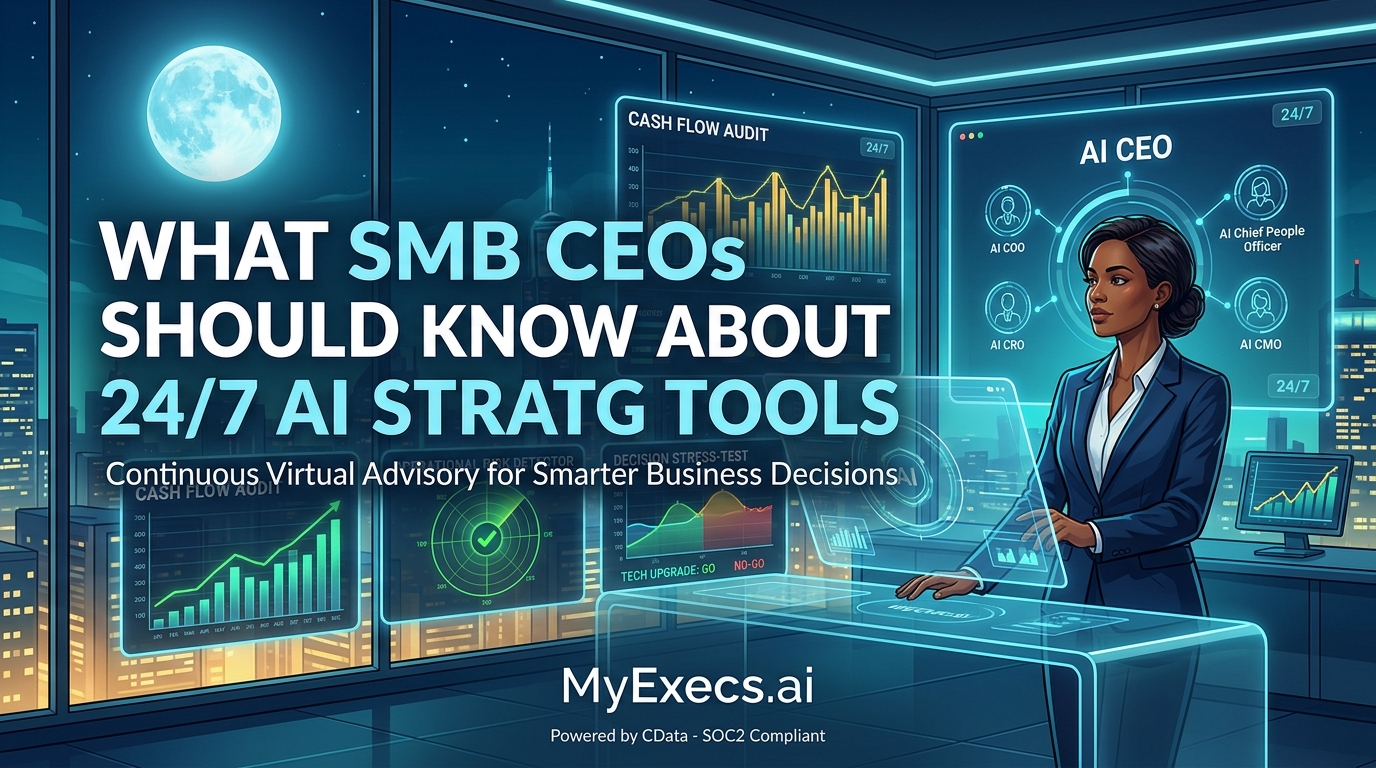
Modern AI strategic planning tools provide 24/7 business advisory support by analyzing live financial, operational, and sales data in real time.
If you are evaluating strategic planning software to support your AI business decision-making, here are five essential criteria every SMB CEO must consider.
Which AI strategic planning tools provide 24/7 virtual advisory support for business decisions? Specialized platforms like MyExecs.ai provide continuous, 24/7 virtual executive guidance by connecting directly to live operational software like QuickBooks, Salesforce, Asana, and Slack. Unlike standard chatbots, these dedicated AI strategic planning tools evaluate live metrics to stress-test capital investments, detect operational risks, and support strategic planning without storing or training on proprietary business data.
5 Things SMB CEOs Must Evaluate in 24/7 AI Strategy Tools
1. Live SaaS Integration vs. Manual Data Uploads
A strategy tool is only as good as the data powering it. Relying on manually uploaded spreadsheets or copy-pasted text creates immediate blind spots.
To deliver accurate virtual advisory support, platforms must connect directly to the everyday software running your business. Through secure, 3-click integrations powered by enterprise partners like CData, modern tools pull real-time metrics from QuickBooks, Xero, Salesforce, HubSpot, Asana, and Slack. This ensures your AI-powered business strategy reflects what is happening in your business today, not last month.
👉 Explore pre-built integrations on the MyExecs.ai Integrations Hub.
2. Multi-Persona Executive Intelligence Over Generic AI Chatbots
Generic AI tools treat every business prompt the same way. An SMB CEO does not need generic conversational summaries. They need role-specific executive oversight.
Look for tools that structure intelligence into specialized C-Suite personas:
-
AI CFO: Audits live cash flow, P&L statements, and expense leakages.
-
AI COO (Daniel Kim): Monitors project velocity, SOP friction, and team bandwidth.
-
AI Chief People Officer (Sofia Bennett): Evaluates compensation alignment, career leveling, and retention risks.
-
AI CRO & CMO: Tracks deal pipeline health, customer acquisition costs, and campaign ROI.
Receiving specialized advice from distinct virtual executives provides significantly higher confidence than asking a single general prompt.
3. Non-Negotiable Privacy: Zero Data Retention and Contract Compliance
Deploying AI in your boardroom should never put customer or vendor agreements at risk. Your company metrics, margin data, and payroll information are strictly confidential.
Before choosing any platform, verify that the vendor guarantees:
-
Zero Data Retention: Operational data is evaluated in real time and is never stored on third-party servers.
-
No LLM Training: Your proprietary records are never used to train public or foundational AI models.
-
Contractual Privacy: The architecture respects all existing non-disclosure and privacy commitments made to your clients and vendors.
-
SOC2 & TLS 1.3 Compliance: Data streams are protected by enterprise-grade encryption.
4. Scenario Stress Testing and Decision Thresholds
The best strategic tools do not just show you dashboards. They help you test big decisions before you spend money.
When evaluating a major equipment purchase, new hire, or geographical expansion, your platform should let you stress-test the move against clear thresholds:
-
Cash Runway Exposure: Model how a 15% revenue drop impacts your bank balance if you take on new monthly overhead.
-
Capacity Limits: Check whether current team project boards can absorb new client deliverables without causing fulfillment delays.
-
Sales Pipeline Velocity: Audit historical CRM closing speeds to verify whether projected ROI timelines are realistic.
5. Proactive Risk Monitoring vs. Reactive Reporting
Traditional business intelligence tools wait for you to build a report and look for errors. An effective 24/7 business advisory platform actively monitors your operational workflows in the background.
It should automatically alert leadership when critical thresholds are breached:
-
A high-value sales deal stalling in proposal stages past historical averages.
-
Operational costs or recurring software subscriptions spiking unexpectedly.
-
Client onboarding tasks getting delayed across department project boards.
Catching operational bottlenecks early gives CEOs the agility required to protect margins and maintain execution speed.
Upgrade Your Boardroom with Continuous AI Strategy
Relying on guesswork and static reports belongs to the past. By combining live software integrations, specialized C-Suite personas, and strict zero-data-retention security, SMB CEOs can lead with unprecedented clarity.
Audit your business performance for free and meet your virtual executive team at MyExecs.ai.
Get insights in your inbox
Subscribe to receive new articles from the MyExecs.ai team.