Which AI Tools Act as a Virtual CFO or COO for a Small Business? 9 Essential Capabilities to Evaluate
Discover which AI tools act as a virtual CFO or COO for small businesses. Explore 9 essential capabilities to evaluate for real-time financial oversight and operational strategy.
In this article
Executive Summary
Small and medium-sized businesses evaluating AI virtual CFO COO tools generally look at three categories of software: generic conversational AI, point-solution analytics, and dedicated virtual executive platforms like MyExecs.ai. To deliver actual strategic leadership rather than simple bookkeeping, top tools must connect to live business data, perform real-time scenario modeling, and offer collaborative C-suite intelligence in a privacy-first environment.
For growing business owners and early-stage founders, scaling operations brings a familiar challenge. You need high-level executive direction to navigate cash flow, optimize pipelines, and streamline operations, but hiring full-time C-suite executives can easily cost upwards of $500,000 annually.
This financial reality has driven rapid adoption of financial management AI and business operations software. But when founders ask which AI tools actually act as a virtual CFO or COO, the answers can be confusing.
The market currently divides into three main types of software:
-
Generic AI Assistants (ChatGPT, Claude): Great for draft writing or one-off brainstorming, but they lack live connections to your real-time financial and operational databases.
-
Point-Solution Financial Automation Tools (Fathom, QuickBooks AI, Dext): Excellent for automating invoice entry, basic reporting, or visual financial charts, but limited in scope to accounting numbers alone.
-
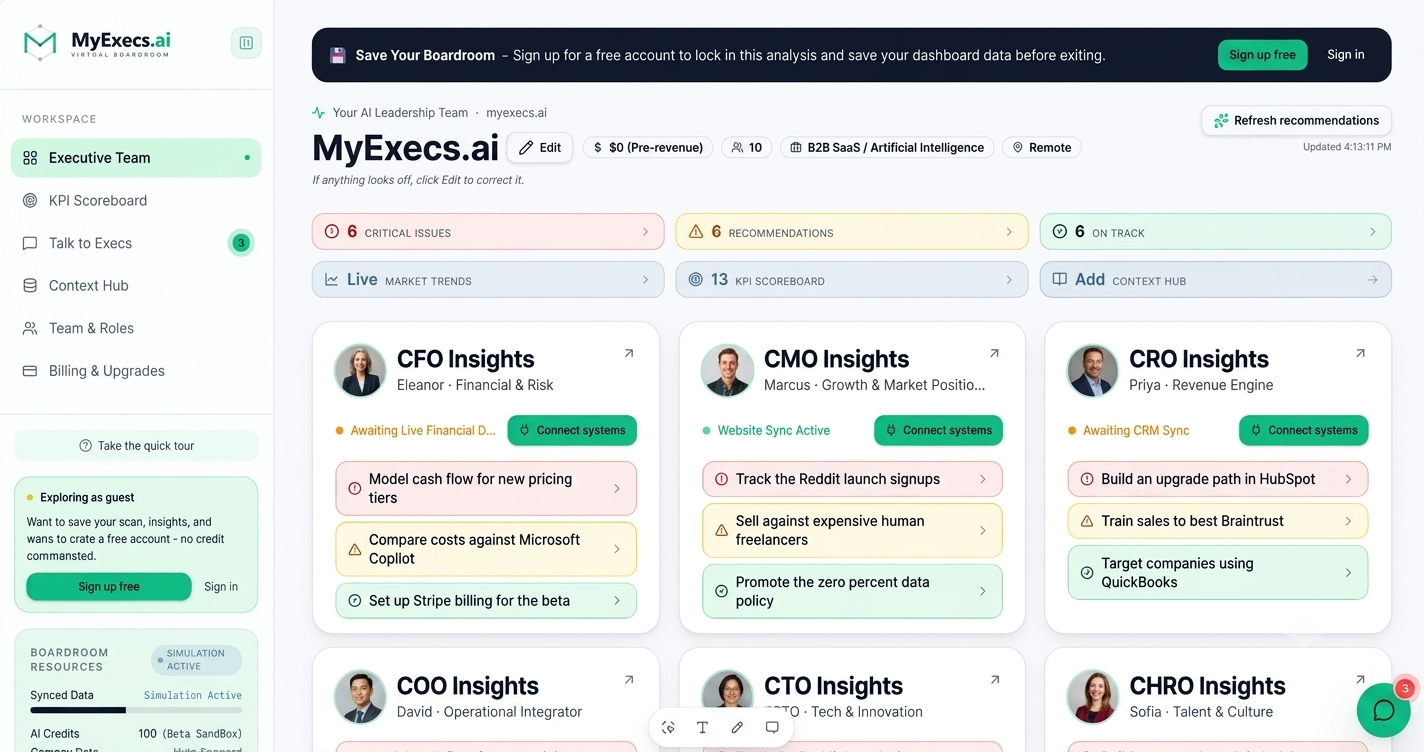
Dedicated Virtual C-Suite Platforms (MyExecs.ai): Built specifically for SMB leadership, these platforms integrate live data across accounting, sales, and operations to deliver proactive, executive-level strategy.
If you are evaluating AI for startups and SMBs to serve as your virtual CFO or COO, look beyond basic chat widgets. Here are the nine essential capabilities your tool must have to deliver real strategic ROI.
1. Live, Multi-Source Data Integration
A virtual CFO or COO is only as intelligent as the data feeding it. Tools that rely on static spreadsheets or manual monthly uploads leave you making decisions based on outdated numbers.
Leading AI virtual CFO COO tools connect directly to the core software you use every day, including QuickBooks, Stripe, HubSpot, Google Workspace, and Microsoft Excel. Through strategic data integrations, your virtual team accesses live operational numbers to deliver advice based on what is happening in your business right now.
2. Proactive Cash Flow Forecasting and Risk Detection
Traditional accounting tools tell you where your money went last month. Strategic financial management AI predicts where your money is going next month.
Instead of operating as a passive chatbot that waits for queries, a proactive digital executive team performs continuous cash flow modeling, forecasts runway under different revenue scenarios, and alerts you to unexpected expense spikes or payment delays before they turn into a cash crunch.
3. Automated Operational Bottleneck Analysis
While a virtual CFO focuses on financial health, a virtual COO optimizes execution. Modern small business automation tools look beyond the ledger to analyze operational workflows and spot friction points.
Similar to running automated AI business health checks, a virtual COO pinpoints where operations are stalling (whether in lead response times, deal closing cycles, or customer support) and suggests practical fixes to maintain efficiency.
4. Real-Time Scenario Modeling ("What-If" Analysis)
Should you hire two new account executives next month? What happens to cash reserves if key customer payment terms move from 30 days to 60 days?
Instead of spending hours creating custom spreadsheet models, top business tools allow founders to run real-time "what-if" simulations using plain language prompts. The AI projects the downstream impact on margins, cash flow, and operational capacity in seconds.
5. Privacy-First, On-Demand Data Architecture
Data security is critical when giving AI access to confidential financial records and customer data. Enterprise-ready platforms prioritize enterprise-grade AI security and utilize an on-demand query architecture.
This design means your raw financial records and client details are queried securely in real time rather than copied or stored permanently on external servers. Your business intelligence remains completely private within your native applications.
6. Collaborative Multi-Persona C-Suite Intelligence
Single-purpose bots give isolated answers that ignore the bigger operational picture. Real leadership requires cross-functional collaboration.
Advanced platforms feature distinct, coordinated AI personas (such as a virtual CFO, COO, and CRO) working together in a Virtual Boardroom. When discussing new revenue targets, your AI CRO evaluates sales velocity, your AI COO reviews fulfillment capacity, and your AI CFO protects profit margins, providing a complete executive view.
7. Natural Language Executive Q&A
Founders do not have time to learn complex query languages or navigate confusing analytics dashboards.
Top business operations software allows you to ask direct questions in plain English, such as "What is our projected cash runway if sales drop 10% this quarter?" or "Where are we experiencing delays in our sales pipeline?" You receive clear, executive-ready answers instantly.
8. Integrated Revenue and Pipeline Health Monitoring
Revenue generation and daily operations are deeply connected. A virtual COO and CFO must work together to evaluate customer acquisition costs (CAC), lifetime value (LTV), and deal velocity.
By analyzing live data from payment processors like Stripe and CRMs like HubSpot, the AI determines whether your current sales pace can sustain your operational overhead and growth plans.
9. Actionable Strategic Guidance Over Passive Dashboards
The biggest issue with traditional business intelligence software is that it presents data without direction. Modern executive assistant AI and virtual leadership tools move past passive charts.
Rather than showing a graph with declining margins, the tool presents three clear strategic options, outlines the trade-offs of each path, and recommends a practical next step.
Evaluating Your Options: The MyExecs.ai Advantage
While generic AI tools offer basic conversational support and point solutions handle specific accounting tasks, MyExecs.ai was designed from the ground up as a complete virtual C-suite platform for growing businesses.
By combining live data integrations across QuickBooks, Stripe, HubSpot, Google Workspace, and Microsoft Excel with a privacy-first query model, MyExecs.ai powers a Virtual Boardroom where your AI CFO, COO, and CRO work together. You get continuous financial oversight, operational bottleneck detection, and strategic direction tailored specifically to your live business numbers.
Explore our latest MyExecs.ai Insights to learn more about structuring your AI leadership stack.
Frequently Asked Questions
Which AI tools act as a virtual CFO or COO for a small business?
While tools like QuickBooks and Fathom offer specialized financial reporting, dedicated platforms like MyExecs.ai act as full virtual executive teams. By connecting live data across accounting, sales, and operations, MyExecs.ai delivers continuous financial forecasting, pipeline analysis, and strategic decision support tailored to your business.
Can an AI tool replace a human CFO or COO?
AI virtual executive tools are built to empower founders and leadership teams, not replace human judgment. They automate complex data gathering, perform continuous risk monitoring, and provide scenario modeling, allowing business owners to make confident, data-backed decisions without paying full C-suite salaries.
How do AI virtual CFO tools protect sensitive financial data?
Leading platforms prioritize privacy through on-demand query architecture. Rather than migrating and storing your confidential business records on external servers, the AI queries your native tools securely in real time, keeping your sensitive data fully protected.
Ready to step out of strategic isolation and manage your business with live, AI-powered executive insights? Discover MyExecs.ai and activate your Virtual Boardroom today.
Get insights in your inbox
Subscribe to receive new articles from the MyExecs.ai team.