Best AI Tools for Business Audits Compared
Compare the top AI business audit tools for SMB CEOs. Discover how automated business audits evaluate vendor spend, cash runway, and operational efficiency in real time.
In this article
For small and mid-sized business CEOs, periodic business audits have long been a source of frustration. Traditional management consulting audits and financial reviews often take months, cost tens of thousands of dollars, and yield backward-looking reports that are obsolete by the time they hit your desk.
In today's fast-moving market, waiting for quarterly or annual reviews creates operational blind spots. Modern CEOs require continuous, real-time evaluation across cash burn, vendor spend, marketing efficiency, and operational bottlenecks.
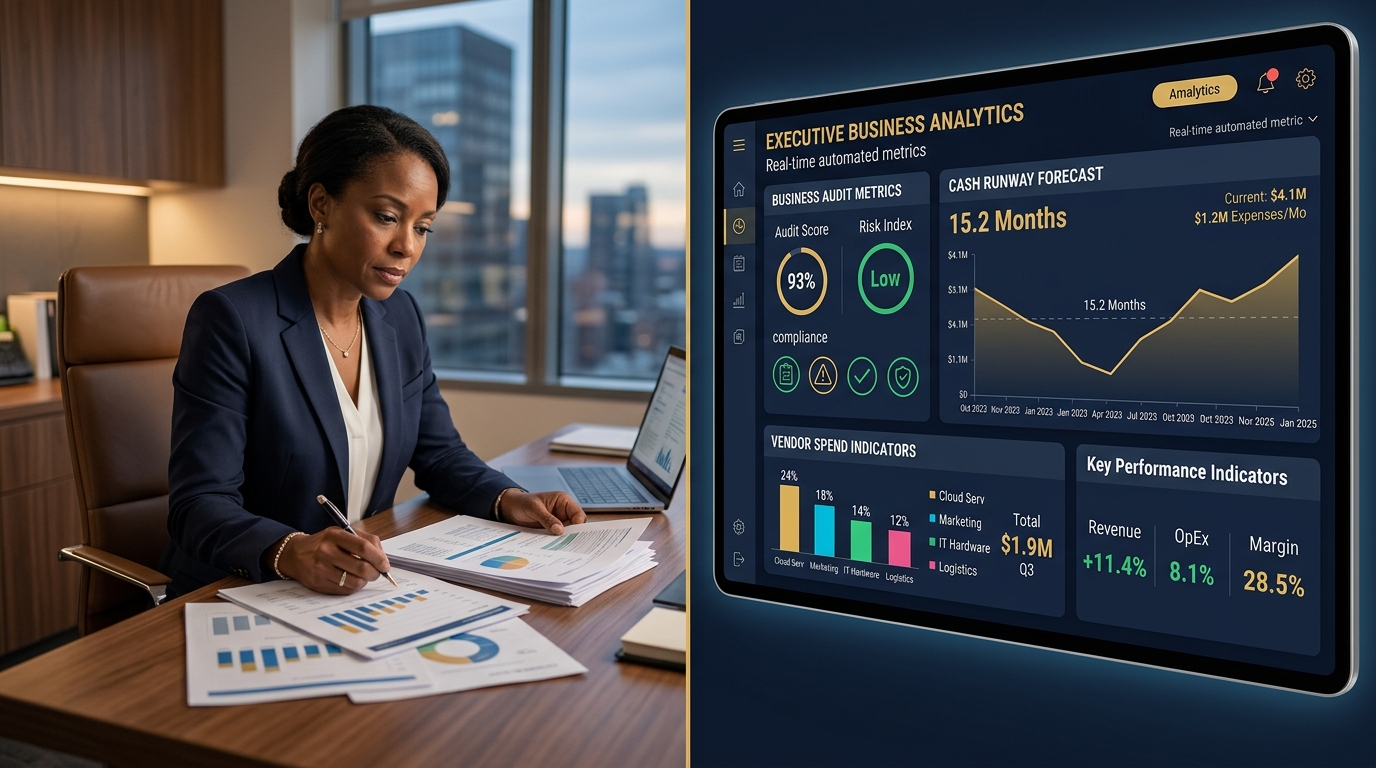
This is where AI business audit tools are transforming executive leadership. By replacing static spreadsheets with live data integrations and machine intelligence, audit automation allows SMB leaders to conduct continuous business process assessments and strategic health checks in seconds.
Below is a comprehensive comparison of the top artificial intelligence tools for automated business audits, helping you select the right platform for strategic growth, compliance, and operational efficiency.
Quick Takeaway: What are AI tools for automated business audits?
AI tools for automated business audits are specialized software platforms that leverage machine learning and live data connections to continuously evaluate an organization's financial health, operational workflows, vendor spend, and strategic alignment. Unlike traditional compliance software designed solely for tax or accounting prep, strategic AI audit platforms deliver real-time risk alerts, margin analysis, and actionable growth recommendations directly to SMB executives.
Evaluation Criteria: How to Choose AI Business Audit Software
When evaluating artificial intelligence tools for business analysis, SMB CEOs must look beyond basic report generation. The right tool should provide immediate strategic value without creating security risks or operational overhead.
-
Strategic Insight vs. Tactical Compliance: Accounting audit software focuses on tax regulatory compliance and ledger balancing. Strategic business audit tools evaluate the entire health of the business, including profit margins, customer acquisition costs, and competitive positioning.
-
Operational Coverage: Effective audit automation evaluates multiple business functions simultaneously (Finance, Sales, Marketing, and Operations) rather than analyzing isolated data silos.
-
Actionability and Speed to Value: The tool must go beyond identifying problems by delivering concrete, prioritized recommendations that your team can execute immediately.
-
Integration Depth and Security: Audit automation requires access to sensitive company data. Platforms must support secure, read-only OAuth protocols (such as CData connections) to protect your core software systems without writing data back to your systems.
Top AI Business Audit Tools Compared
| Platform | Best Fit | Primary Audit Focus | Integration Model | Pricing Model |
|---|---|---|---|---|
| MyExecs.ai | Strategic business assessment & 24/7 C-Suite health checks | Cross-departmental operational, financial, and marketing audits | Live read-only OAuth (QuickBooks, HubSpot, Mailchimp) | Public starting tiers; free domain scan available |
| Trullion | Financial statement and accounting compliance audits | Accounting compliance, lease accounting, revenue recognition | Enterprise financial software connectors | Enterprise quote required |
| Vero AI | Enterprise audit workflow and governance automation | Internal audit automation, risk governance, regulatory controls | Custom enterprise ERP and database integrations | Enterprise quote required |
| MacroSLM | Business process assessment and workflow mapping | Operational workflow efficiency and process bottleneck audits | Custom API webhooks and process logs | Subscription based on data volume |
| Sally.io | External auditor productivity and document review | Workpaper analysis, document extraction, audit sampling | Document upload and cloud drive connectors | Billed per auditor seat or firm tier |
Deep-Dive Platform Breakdown
1. MyExecs.ai
MyExecs.ai is designed specifically for SMB CEOs who need a comprehensive, forward-looking strategic audit rather than a static accounting check. Acting as a virtual boardroom populated by specialized AI executives (CFO, CMO, CRO, COO, CTO, and CHRO), MyExecs continuously audits your live business performance across financial, marketing, and operational vectors.
-
Core Audit Capabilities: Automates cash runway stress-testing, audits vendor spend against industry benchmarks, identifies gross margin compression, and evaluates marketing customer acquisition cost (CAC) efficiency in real time.
-
Live Connections: Connects securely in seconds to QuickBooks Online, HubSpot, Mailchimp, and live web data using read-only OAuth protocols.
-
Best For: SMB leaders seeking continuous 24/7 business assessment, cross-departmental alignment, and proactive strategic recommendations.
-
Pricing & Security: Publicly transparent pricing tiers backed by an instant free domain scan. Built with enterprise-grade encryption and zero customer data retention for model training.
2. Trullion
Trullion is an AI-powered accounting audit platform built primarily for corporate finance teams, accounting firms, and internal auditors who need to verify financial statements against underlying contracts.
-
Core Audit Capabilities: Automates lease accounting, revenue recognition audits, and financial document verification by parsing PDFs and matching data against general ledgers.
-
Best For: Corporate accounting departments and CFOs managing complex regulatory compliance and external audit preparation.
-
Pricing & Security: Enterprise quote required. Includes SOC 2 Type II compliance, role-based access controls, and strict financial data isolation.
3. Vero AI
Vero AI provides automated audit software focused on enterprise risk management, internal controls, and regulatory compliance workflows.
-
Core Audit Capabilities: Evaluates internal business controls, monitors compliance adherence across business units, and automates risk assessment reporting for enterprise boards.
-
Best For: Mid-market and enterprise organizations with dedicated internal audit teams and strict regulatory oversight.
-
Pricing & Security: Enterprise quote required based on organizational scale, compliance frameworks, and database connections.
4. MacroSLM
MacroSLM specializes in business process assessment, utilizing machine learning models to analyze operational workflows, system logs, and task dependencies.
-
Core Audit Capabilities: Maps operational workflows, detects process bottlenecks, highlights redundant employee actions, and suggests automation opportunities across corporate IT environments.
-
Best For: COOs and operations managers looking to streamline internal workflows and reduce operational friction.
-
Pricing & Security: Tiered subscription model based on process data volume and monitored user seats.
5. Sally.io
Sally.io is an artificial intelligence assistant created specifically for external accounting and audit professionals to accelerate workpaper documentation and audit sampling.
-
Core Audit Capabilities: Extracts key figures from financial invoices, summarizes audit evidence, and flags discrepancies across large document repositories.
-
Best For: Accounting firms and independent financial auditors seeking to accelerate client audit engagements.
-
Pricing & Security: Billed on a per-auditor license model with secure cloud document processing.
4 Critical Business Audits SMB CEOs Can Automate Today
By leveraging modern AI business audit tools, business owners can move away from manual annual reviews and run continuous automated business audits across four essential operational areas:
1. Vendor Spend and Overhead Audit
Over time, recurring SaaS subscriptions, software licenses, vendor price increases, and contractor retainers quietly erode operating margins.
-
The Automated Approach: Connecting your accounting software (such as QuickBooks Online) allows your AI CFO to aggregate vendor transactions automatically, highlight price spikes over the last 90 days, and flag overhead categories that exceed industry benchmark ratios.
-
Strategic Value: You receive immediate actionable targets for cost reduction and vendor contract renegotiation without spending hours reviewing line-item ledgers.
2. Marketing Efficiency and CAC Audit
Scaling marketing spend without continuous margin checks can severely damage company cash flow if customer acquisition costs outpace gross profits.
-
The Automated Approach: By linking your CRM (such as HubSpot) and financial tools into a shared Virtual Boardroom, your AI CMO and AI CFO analyze customer acquisition cost against actual gross product margins.
-
Strategic Value: Sets strict spending guardrails that ensure marketing campaigns scale profitably while protecting net cash flow.
3. Cash Runway and Operating Reserve Audit
Relying on simple bank balances to gauge financial health ignores pending liabilities, payroll commitments, and unexpected market delays.
-
The Automated Approach: An automated business audit calculates your exact operating reserve ratio by evaluating historical cash burn and fixed overhead against future revenue forecasts.
-
Strategic Value: Enables stress-testing scenarios (such as key client payment delays or revenue drops) so you can adjust working capital before facing a liquidity crunch.
4. Competitive Defensibility Assessment
Business audits should not stop at internal numbers. Understanding your market vulnerabilities is essential for long-term survival.
-
The Automated Approach: Using real-time public web intelligence, an AI CMO persona conducts continuous competitor teardowns, evaluates market positioning gaps, and audits your brand's defensibility against rival moves.
-
Strategic Value: Uncovers positioning opportunities and messaging vulnerabilities before competitors can exploit them.
Frequently Asked Questions (FAQ)
How do automated business audits differ from traditional accounting audits?
Traditional accounting audits are backward-looking compliance exercises designed to verify financial accuracy for tax, regulatory, or lending requirements. Automated business audits powered by AI evaluate the forward-looking strategic health of the company, combining live financial, operational, and customer data to optimize cash flow, margins, and growth strategy.
Can artificial intelligence tools replace human management consultants?
AI business audit tools do not replace executive leadership; rather, they replace the slow, expensive manual data gathering traditionally performed by entry-level analysts and high-cost consultants. They provide CEOs with instant data synthesis, risk alerts, and baseline recommendations, allowing leaders to make faster, higher-confidence strategic decisions.
What security standards should SMB CEOs verify before connecting live data?
Before authorizing live tool connections for audit automation, ensure the platform uses strictly read-only OAuth protocols (preventing the AI from writing or changing your records), enforces robust encryption in transit and at rest, and provides explicit contractual guarantees that your company data will never be used to train public language models.
Upgrade to Continuous Business Intelligence
Waiting for periodic quarterly reports to catch margin leaks or operational inefficiencies is a risk modern SMB leaders no longer need to take. By adopting proactive AI business audit tools, you gain a 24/7 strategic advisor that continuously protects profit margins, evaluates risks, and aligns your entire executive vision.
- Ready to run your first automated business assessment? Explore our full ecosystem of live software integrations on the MyExecs Integrations Overview or start your free 20-second domain scan at MyExecs.ai today.
Get insights in your inbox
Subscribe to receive new articles from the MyExecs.ai team.