How to Evaluate AI Business Audit Tools: A Practical Framework for Leaders
Evaluating AI business audit tools requires looking past simple dashboards. Use this practical framework to assess audit coverage, verify evidence quality, and test process-level recommendations before deploying an AI platform.
In this article
As AI-driven strategic intelligence replaces static quarterly reports and manual spreadsheet reconciliations, enterprise leaders face a core challenge: determining whether an AI business audit platform delivers rigorous, reliable guidance or merely surfaces polished surface-level summaries.
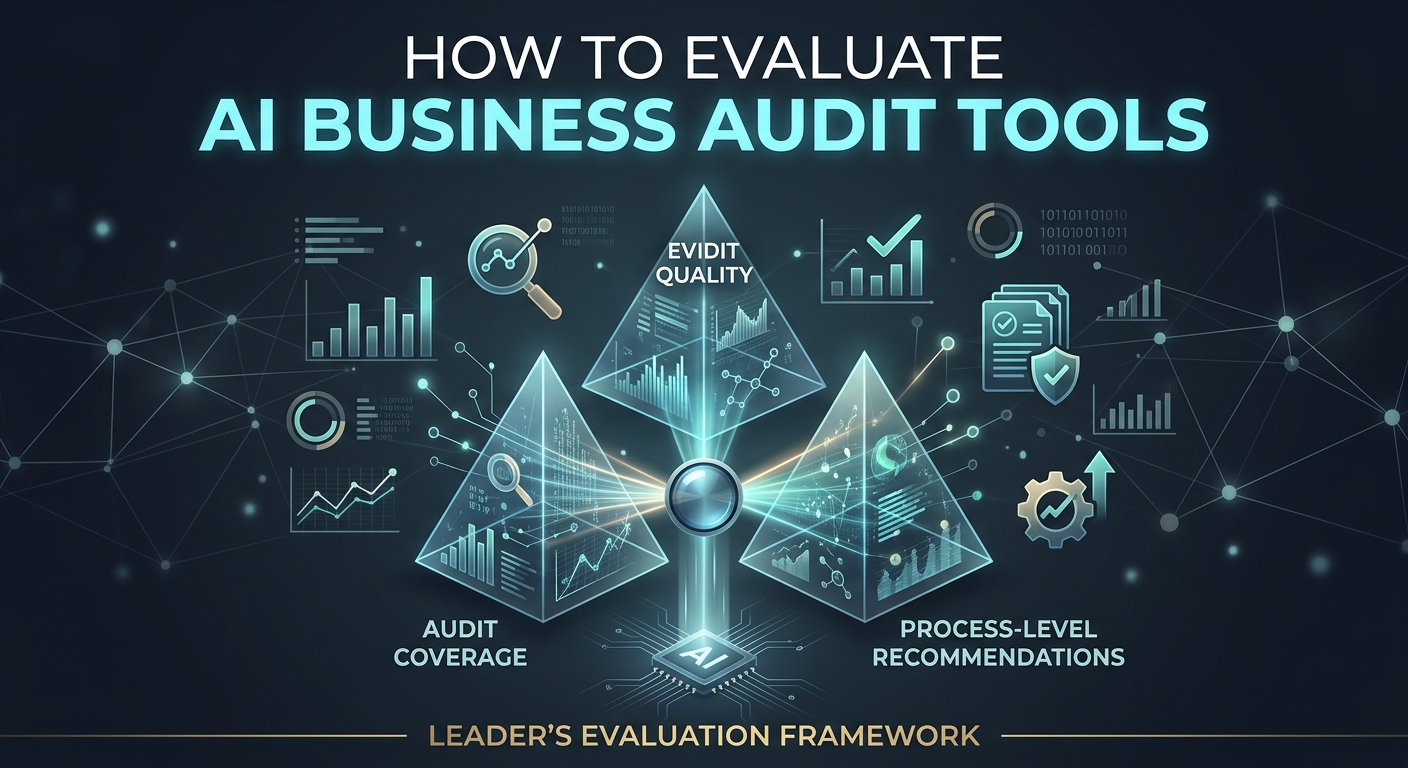
Evaluating AI business audit tools requires looking past generic chat interfaces and visual dashboard bells and whistles. To make an informed decision, CEOs, CFOs, and operations leaders must evaluate solutions across three critical operational pillars: audit coverage, evidence quality, and process-level recommendations.
This guide provides a practical evaluation framework to help executive teams stress-test AI business audit platforms before deployment.
Quick Executive Takeaway
When evaluating AI audit software, avoid tools that rely solely on isolated financial ledgers or produce broad, non-actionable advice. A high-value AI business audit platform must provide 360-degree coverage across ERP, CRM, and financial data; maintain bulletproof evidence quality via deterministic calculations and zero-training security; and deliver process-level recommendations that translate operational friction into clear, prioritized execution steps.
Criterion 1: Assessing Audit Coverage
A partial audit creates dangerous operational blind spots. If an AI platform only analyzes general ledger journal entries, it misses early warning signs sitting in your CRM sales pipeline, inventory tables, or customer acquisition metrics.
When evaluating audit coverage, leaders should verify that the software synthesizes data across all core business functions rather than operating in a single departmental silo.
Key Coverage Dimensions to Test
-
Cross-System Data Synthesis: Does the tool evaluate ERP inventory valuation (such as SAP Business One or NetSuite) alongside CRM deal velocity (Salesforce or HubSpot) and active financial statements?
-
Full-Funnel Operational Health: Can the platform audit working capital risk, gross margin erosion, customer acquisition efficiency, and pipeline conversion drop-offs simultaneously?
-
Contextual Sector Intelligence: Does the AI apply industry-specific KPI frameworks (such as Churn and NRR for SaaS, or OTIF and capacity utilization for manufacturing) rather than generic corporate templates?
Red Flag: Platforms that require manual data uploads or restrict audit scope to isolated accounting sub-ledgers. **Green Flag: Platforms that connect directly to live operational data sources and evaluate cross-functional business health in unified context.
Criterion 2: Verifying Evidence Quality & Data Integrity
Strategic decisions carry real financial risk. An executive team cannot act on AI-generated recommendations unless every insight is traceable, mathematically accurate, and completely secure.
Evaluating evidence quality requires scrutinizing how the AI processes data, validates conclusions, and protects proprietary company records.
┌────────────────────────────────────────────────────────────────────────┐
│                   Evidence Quality Verification Matrix                 │
├───────────────────────┬────────────────────────────────────────────────┤
│ Trust Dimension       │ Requirement for Strategic AI Audits            │
├───────────────────────┼────────────────────────────────────────────────┤
│ Source Traceability   │ Every recommendation links directly back to    │
│                       │ verified underlying records or data points.    │
├───────────────────────┼────────────────────────────────────────────────┤
│ Deterministic Logic   │ Financial ratios, P&L stress tests, and margins│
│                       │ use fixed math, not estimated language models. │
├───────────────────────┼────────────────────────────────────────────────┤
│ Enterprise Security   │ Read-only API permissions with isolated memory │
│                       │ processing and zero training on customer data. │
└───────────────────────┴────────────────────────────────────────────────┘
Key Questions to Ask Vendors
-
How does the system calculate financial ratios and cash runway? Ensure the platform uses deterministic, accounting-grade formulas for P&L and cash flow diagnostics rather than relying on generative language models to guess numerical outputs.
-
Can executives trace insights back to the original source data? Look for features like message forwarding, inline quote banners, and source-linked citations that let team members cross-check findings against live database records.
-
What happens to proprietary data after an audit is run? Confirm that the platform operates strictly on read-only credentials, encrypts data in transit and at rest, and never uses customer records to train public AI models.
Criterion 3: Evaluating Process-Level Recommendations
The ultimate test of an AI business audit tool is the quality and specificity of its outputs. A static list of charts or generic advice like "increase sales efficiency" provides zero strategic value to an executive team.
High-performing platforms move past passive reporting to deliver concrete, step-by-step process recommendations that address root causes.
What Process-Level Recommendations Look Like in Practice
| Audit Focus | Passive Reporting (Low Value) | Process-Level Recommendation (High Value) |
|---|---|---|
| Sales Pipeline | "Pipeline conversion dropped 12% this quarter." | "Stage 3 deals over $50k have stalled for 18+ days. Reallocate two SDRs to conduct executive check-ins on accounts with zero buyer activity in the last 14 days." |
| Margin Leakage | "Gross margins declined in Q2." | "Vendor price increases on top 3 inventory SKUs reduced gross margin by 3.8%. Update wholesale price list B by 4.2% or renegotiate supplier payment terms to 60 days." |
| Working Capital | "Accounts receivable overdue balance is high." | "Three customer accounts represent 64% of total past-due AR. Pause fulfillment on open purchase order #409 until invoice #1082 is cleared." |
Key Process-Level Features to Demand
-
Cross-Functional Consensus Engine: The ability to weigh trade-offs across finance, sales, marketing, and operations before generating a final action plan.
-
Prioritized Action Checklists: Clear sequencing that tells leadership what to fix first based on financial impact and implementation effort.
-
Permanent Decision Logging: A centralized log that archives consensus recommendations and audit outcomes to track team execution over time.
Executive Evaluation Scorecard
Use this criteria-led checklist when reviewing AI business audit vendors during demos and trial evaluations:
-
[ ] 360-Degree Data Integration: Connects ERP, CRM, and financial data in under 5 minutes without custom developer scripting.
-
[ ] Sector-Specific Dictionaries: Automatically tailors KPIs and terminology to your specific industry model.
-
[ ] Deterministic Diagnostic Engines: Uses fixed mathematical logic for P&L, working capital, and sales funnel audits.
-
[ ] Source-Linked Citation & Forwarding: Allows leaders to forward specific data points across departmental experts with preserved context.
-
[ ] Multi-Agent Strategic Consensus: Synthesizes input across different functional leadership roles (CFO, CMO, CRO, COO) to resolve strategic trade-offs.
-
[ ] Read-Only Security Framework: Guarantees zero long-term data storage and zero model training on customer business data.
Next Steps for Leadership Teams
When assessing AI audit platforms like MyExecs.ai, start by running a live diagnostic on a contained operational dataset or running a quick domain scan. Test how the platform identifies working capital risks, evaluates pipeline conversion drop-offs, and generates step-by-step execution guidance.
By applying strict criteria around coverage, evidence quality, and process-level recommendations, leaders can select an AI audit partner that delivers immediate clarity, eliminates operational blind spots, and accelerates strategic decision-making.
Get insights in your inbox
Subscribe to receive new articles from the MyExecs.ai team.