Turning Competitor Weaknesses into SMB Growth: A Step-by-Step AI Strategic Intelligence Workflow
Learn how SMB CEOs can use AI strategic intelligence to analyze competitor review patterns, spot market gaps, and turn rival weaknesses into growth.
In this article
For small and mid-sized business (SMB) CEOs, market share is rarely won by outspending enterprise rivals on advertising. It is won by out-maneuvering them. Enterprise competitors often suffer from slow product iterations, rigid pricing tiers, and bloated support channels. These operational friction points leave distinct digital footprints across customer review sites, marketing pages, and industry discussions.
Traditional competitive intelligence required hiring expensive strategy consultants or spending weeks manually combing through competitor materials. By leveraging automated competitive intelligence tools and virtual advisory teams, SMB leaders can spot market gaps, prioritize threats, and execute high-converting counter-positioning strategies in minutes.
This step-by-step tutorial demonstrates how SMB CEOs can turn competitor weakness patterns into scalable business strategy using the strategic intelligence capabilities of MyExecs.ai.
Quick Takeaway: How do SMBs use AI for competitive strategic intelligence?
AI-driven strategic intelligence automates competitive benchmarking by scanning competitor digital footprints, indexing public review data, and performing real-time head-to-head teardowns. By combining automated competitive analysis with an integrated virtual boardroom, SMB CEOs can identify where rivals lose customers, update messaging frameworks, and align cross-departmental execution across sales, marketing, and finance without manual spreadsheet tracking.
Step 1: Automated Competitor Discovery and Signal Mapping
The initial phase of strategic analysis requires establishing an objective baseline of your business and top competitors without manual data entry.
-
Run the Automated Web Scan: Enter your company domain on MyExecs.ai. The system reads your public homepage and core web pages, searches web directories and news sources, and extracts your company profile, industry classification, headquarter details, and social channels.
-
Review Initial Competitor Benchmarks: During the scan, the system identifies primary market competitors, maps their social footprints, and generates an initial SWOT matrix alongside positioning scores for your business and rivals.
-
Calibrate the Competitive Baseline: Access your company workspace to confirm or refine the competitor list, reordering priority rivals or adding niche incumbents that impact your local market.
Data Integrity Note: If public website data is incomplete, fields remain unpopulated rather than generating fabricated figures, ensuring your competitive baseline stays grounded in real data.
[Company Domain Scan]
        │
        ├──> Extracts Public Data & Web Signals
        ├──> Maps Primary Competitors & Social Links[cite: 8]
        └──> Generates Baseline SWOT & Positioning Scores[cite: 8]
Step 2: Deep-Dive Competitor Teardowns and Loss-Point Extraction
Once top rivals are identified, move beyond surface-level website reviews to analyze where competitors fail their customers.
-
Launch the CMO Studio: Open the Executive Dashboard and navigate to the CMO Studio.
-
Execute a Competitor Teardown: Select a key rival to run an automated, in-depth Competitor Teardown. The system reads the rival's homepage, pricing tiers, feature lists, and positioning pages in real time to generate a structured head-to-head evaluation.
-
Analyze Customer Loss Points: Review the teardown output to pinpoint exact areas where the competitor loses customers. Look specifically for common friction patterns:
-
Opaque Pricing Tiers: Complex, hidden enterprise quotes that frustrate mid-market buyers.
-
Feature Bloat: Overwhelming product interfaces that delay customer onboarding.
-
Service Gaps: Slow support response times and rigid service contracts.
-
-
Incorporate Unstructured Review Data: Upload PDF exports or text transcripts of customer review feeds (such as G2, Capterra, or Trustpilot reviews) directly into your workspace Knowledge Base. The platform automatically extracts, passages, and indexes the document text into searchable intelligence for your executive team.
Step 3: Mapping Market Gaps with the Competitor Benchmark Matrix
To prioritize threats and opportunities, qualitative weaknesses must be evaluated against structured evaluation criteria.
-
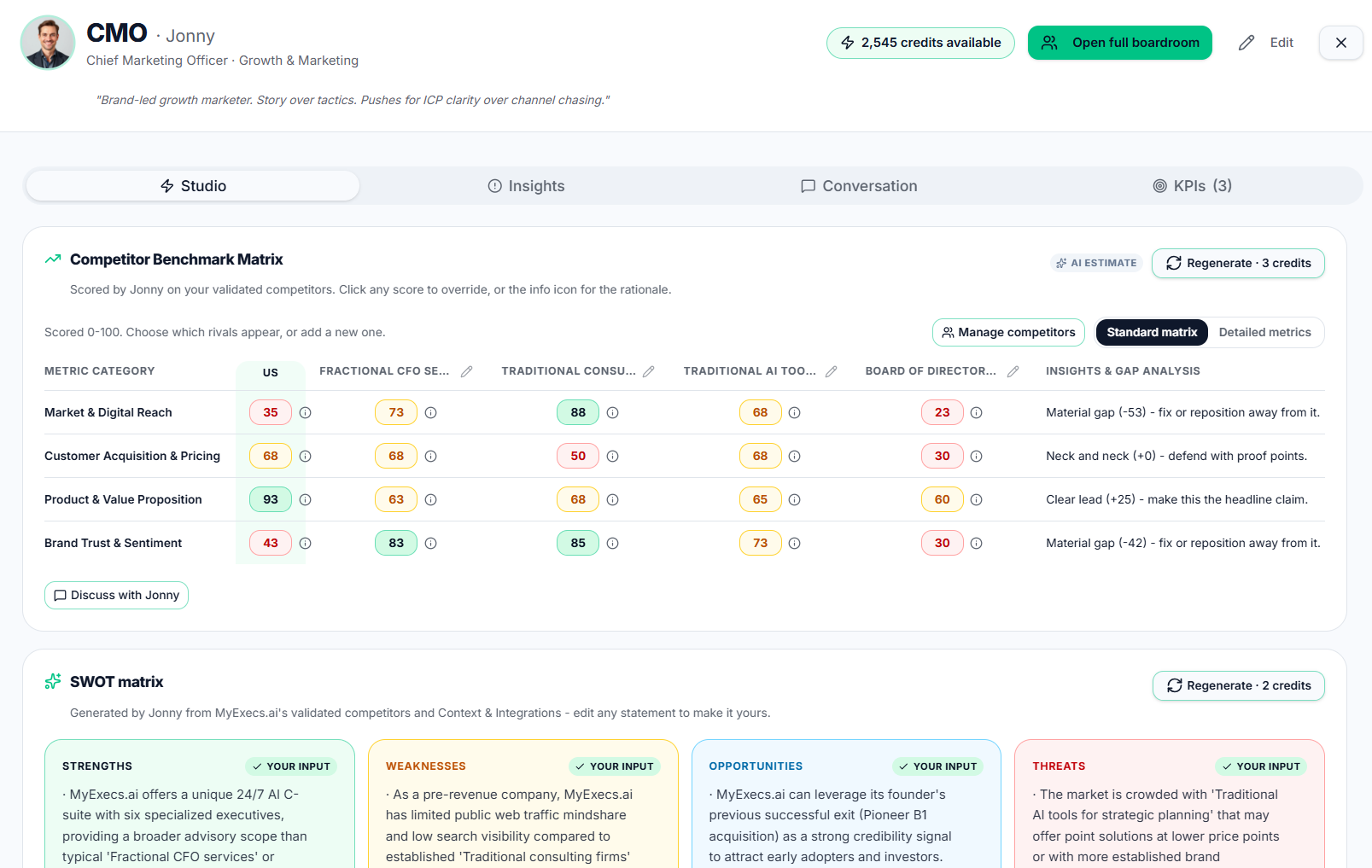
Open the Competitor Benchmark Matrix: Inside the CMO Studio, view the criterion-by-criterion scoring table for each competitor.
-
Evaluate Core Dimensions: Compare your business against rivals across key metrics:
-
Value Prop Clarity: How effectively does the rival communicate their core outcome?
-
Channel Visibility: Which channels (SEO, social, direct) drive their primary traffic?
-
Price-to-Value Alignment: Where are customers paying enterprise rates for outdated software or services?
-
-
Identify High-Margin Market Gaps: Focus on areas where rivals score high on pricing but low on customer satisfaction or delivery speed. These intersections represent your highest-converting growth opportunities.
| Strategic Dimension | Rival A (Legacy Incumbent) | Rival B (Low-Cost Alternative) | Your Positioning Opportunity |
|---|---|---|---|
| Pricing Structure | Opaque Enterprise Contracts | Low-Cost Monthly Subscription | Transparent, Performance-Tiered Pricing |
| Data Security | Generic Cloud Hosting | Undisclosed Retention | Strict 0% Data Retention Standard |
| Integration Depth | Manual File Uploads | Basic Webhook Scripts | Live Read-Only OAuth Connections |
| Customer Loss Point | Slow Support & Onboarding | Minimal Support Features | 24/7 Virtual Executive Oversight |
Step 4: Building Counter-Positioning Playbooks and Ideal Customer Messaging
With competitor weakness patterns clearly defined, translate market gaps into updated marketing and sales messaging.
-
Generate the ICP and Messaging Matrix: Inside the CMO Studio, run an ICP & Messaging Matrix analysis to define updated Ideal Customer Profiles based on identified market pain points, buyer objections, and core value propositions.
-
Develop Counter-Positioning Angles: Use the instructions input in the Competitor Teardown tool to steer the output toward specific positioning angles:
-
The Anti-Friction Angle: Target buyers frustrated by manual data entry or long onboarding cycles by emphasizing automated integration.
-
The Transparency Angle: Target buyers tired of hidden enterprise fees by publishing clear, predictable pricing models.
-
-
Execute a Defensibility Audit: Run a Defensibility Audit in the CMO Studio to evaluate how well your revised strategy protects your business against emerging market trends and competitive shifts.
Step 5: Multi-Executive Boardroom Validation across Finance, Sales, and Ops
A marketing positioning angle is only effective if your operating model and financial metrics support it. The final step involves validating your growth strategy across your entire executive team.
-
Enter the Virtual Boardroom: Open a multi-executive Boardroom conversation to discuss the strategy with your full C-Suite simultaneously.
-
Stress-Test Financial Impact (AI CFO): Ask your virtual CFO to evaluate proposed pricing changes or acquisition costs. On paid plans with connected accounting tools (such as QuickBooks or Stripe), your CFO references live financial context to ensure profit margins remain protected.
-
Align Sales Battlecards (AI CRO): Have your virtual CRO translate the CMO's competitor teardown into actionable sales battlecards for your pipeline. The CRO focuses on handling pricing objections and highlighting competitor loss points during live sales calls.
-
Verify Operational Fulfillment (AI COO): Ask your virtual COO to review capacity and delivery workflows to confirm that rapid customer acquisition will not create delivery bottlenecks.
-
Shared Intelligence Memory: Because all virtual executives share workspace memory and key business facts, insights gained during your competitor analysis automatically inform future recommendations across all Studios.
                     [MyExecs Virtual Boardroom]
                                 │
    ┌────────────────────────────┼────────────────────────────┐
    ▼                            ▼                            ▼
[AI CMO][cite: 6, 14]       [AI CRO][cite: 6, 15]       [AI CFO][cite: 6, 15]
Competitor Teardowns         Sales Battlecards            Margin & Pricing
& ICP Messaging              & Pipeline Strategy          Impact Analysis
Implementation Checklist for SMB CEOs
To turn competitive analysis into immediate growth, complete this executive execution checklist:
-
Run Initial Scan: Complete a free web scan of your company domain to establish your baseline SWOT and competitor list[cite: 8].
-
Execute 2 Teardowns: Run detailed Competitor Teardowns on your top two direct rivals in the CMO Studio.
-
Upload Review Data: Drag and drop recent customer feedback or industry review transcripts into your Knowledge Base.
-
Refine ICP Messaging: Update your value proposition using the ICP & Messaging Matrix.
-
Boardroom Review: Convene your Virtual Boardroom to stress-test your revised strategy across sales, operations, and finance before launching your campaigns[cite: 11].
By shifting from manual, periodic competitor reviews to continuous, AI-driven strategic intelligence, SMB leaders can spot market opportunities faster, capitalize on rival weaknesses, and drive predictable business growth.
Get insights in your inbox
Subscribe to receive new articles from the MyExecs.ai team.